Japanese dragon tattoos are among the most recognizable motifs associated with Japanese tattoo art, admired for their flowing compositions, dramatic movement, and intricate details. Japanese dragons appear throughout the country’s mythology, folklore, religion, and visual culture, where their associations vary by context and can include water, rainfall, protection, power, and wisdom. In tattoo compositions, dragons are often surrounded by waves, clouds, wind bars, flowers, and other traditional-inspired elements, creating artwork that naturally follows the contours of the body.
How to Choose the Right Japanese Dragon Tattoo
Start by deciding on the scale and movement of the dragon. Large, winding compositions work especially well across the back, chest, arm, or thigh because these placements provide enough space for the dragon’s body, claws, scales, and surrounding background. Consider whether you prefer a bold traditional-inspired color palette or a black-and-grey interpretation. Peonies, chrysanthemums, lotus flowers, waves, clouds, and wind-inspired backgrounds can help build a larger composition, but combinations of motifs can have specific artistic and seasonal conventions. Working with a tattoo artist knowledgeable about Japanese tattoo traditions can help create a more cohesive and culturally informed design.
Japanese Dragon Tattoo Ideas
Image 1
This Japanese dragon tattoo combines intricate black linework with vivid red floral accents. The dragon coils vertically along the limb in a flowing S-shaped composition, creating a strong sense of movement. Its elongated horns, open mouth, sharp teeth, whiskers, claws, and individually outlined scales give the creature a fierce yet elegant appearance.
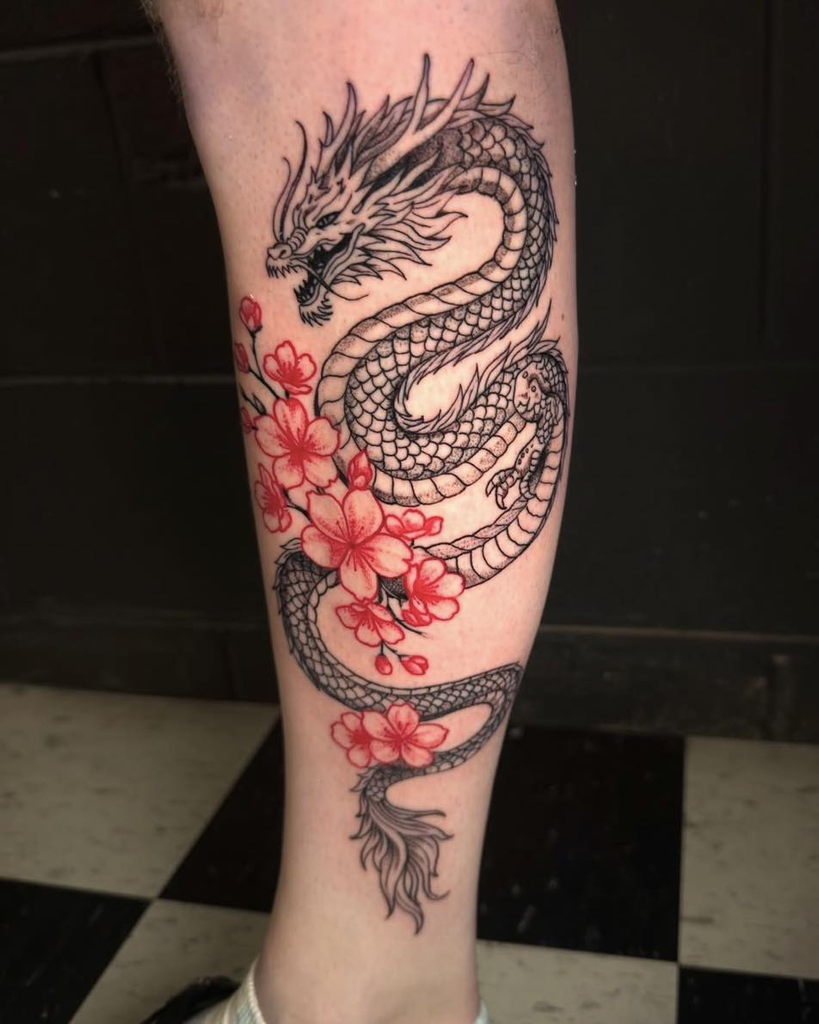
Delicate stippling and light shading add texture without making the design excessively dark. Clusters of red and pink cherry blossoms weave across the dragon’s body, providing a striking contrast against the monochrome creature. The extended tail and blossoms naturally follow the limb, producing a graceful, balanced composition.
Image 2
This bold Japanese-inspired dragon tattoo uses saturated red, orange, black, and muted gray tones to create a dramatic sleeve-like composition. The dragon’s large face dominates the center, featuring intense orange eyes, pronounced horns, sharp fangs, and expressive facial contours. Its heavily scaled body coils around the limb, while dense black shading establishes a powerful background and makes the red details especially prominent.

Flame-like red forms travel between the coils, reinforcing the energetic movement of the creature. Thick outlines and substantial color packing give the tattoo a traditional, graphic quality. Overall, the piece feels fierce, commanding, densely composed, and visually powerful.
Image 3
This blackwork Japanese dragon tattoo presents a clean, highly detailed creature twisting through stylized clouds. The dragon has a long serpentine body covered with carefully repeated scales, while its underside is divided into broad segmented plates. Sharp horns, an open mouth, pointed teeth, flowing whiskers, and a spiked mane create an expressive head. Several clawed limbs emerge naturally from the curved body, strengthening the sense of motion.
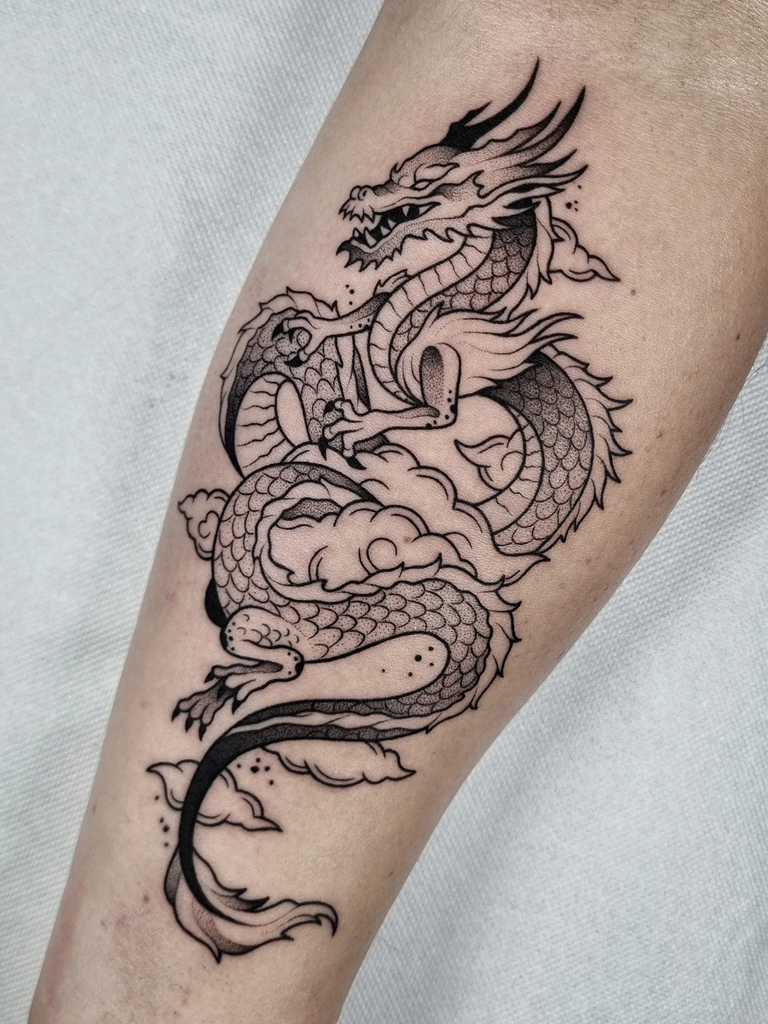
Soft stippling inside the scales and selected areas adds subtle tonal depth while preserving plenty of negative space. Rounded cloud forms overlap the dragon’s coils, giving the composition atmosphere and a distinctly East Asian visual character.
Image 4
This finely rendered black-and-gray dragon tattoo shows the creature tightly wrapped around a Japanese-style sword. The dragon’s long body forms several compact coils, allowing the straight blade to become the central structural element of the composition. Detailed scales, segmented belly plates, clawed feet, flowing whiskers, horns, and a textured mane give the creature considerable visual complexity.

Dark shading across the upper body gradually transitions into lighter areas, creating depth while maintaining delicate linework. Wispy flame or smoke-like contours surround the dragon without overwhelming it. The sword adds a strong vertical axis, while the dragon’s curves create movement and contrast throughout the elongated design.
Image 5
This elegant black-and-gray dragon tattoo takes a softer botanical approach, intertwining a slender dragon with large flowers, leaves, and delicate branches. The dragon’s serpentine body winds vertically down the limb, repeatedly disappearing behind floral elements before emerging again. Fine scales and controlled stipple shading provide texture, while the head features elongated antler-like horns, flowing whiskers, and a restrained expression.
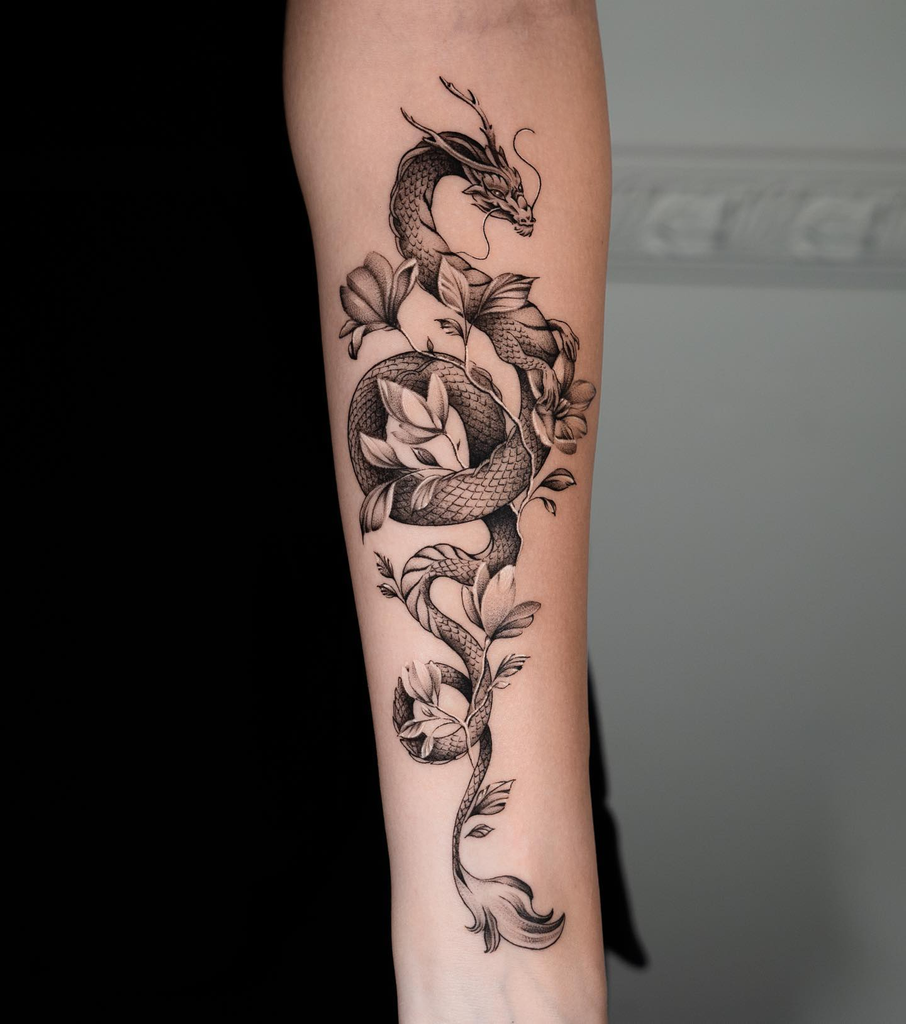
Large blossoms interrupt the darker body with areas of open skin, preventing the composition from becoming visually heavy. Smaller leaves extend outward to balance the narrow format. The flowing tail finishes the design gracefully, giving the entire tattoo an ornamental, refined appearance.
Image 6
This Japanese-inspired dragon tattoo creates a dramatic contrast between a black-and-gray dragon and vibrant red and pink flowers. Positioned across the upper arm, the dragon curves downward through a dense arrangement of large peony-like blossoms and smaller cherry blossoms. Its open mouth, layered mane, detailed scales, claws, and segmented underside give the creature a strong traditional appearance.
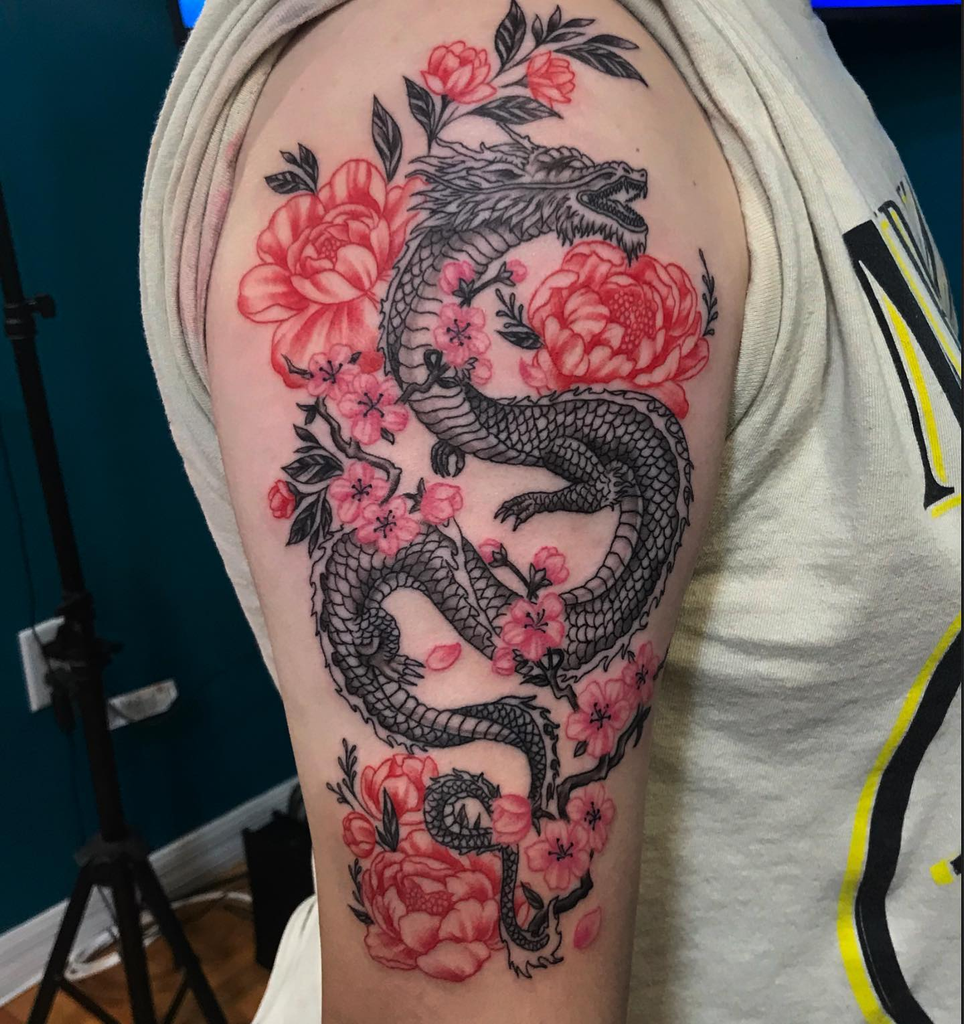
The black leaves provide additional contrast and connect the floral elements throughout the composition. Red petals and blossoms repeatedly overlap the dragon, creating depth and movement. The large scale of the design allows the body to follow the natural curvature of the arm beautifully and dynamically.
Image 7
This dramatic Japanese dragon tattoo combines detailed blackwork with selective red accents to create a cinematic vertical composition. A dark serpentine dragon rises through swirling smoke beneath a large crimson sun, while a traditional pagoda appears silhouetted in the background. The dragon features dense scales, prominent horns, long whiskers, sharp claws, and a fierce open mouth. Small red blossoms cross the lower portion, visually connecting the creature with the surrounding scenery.
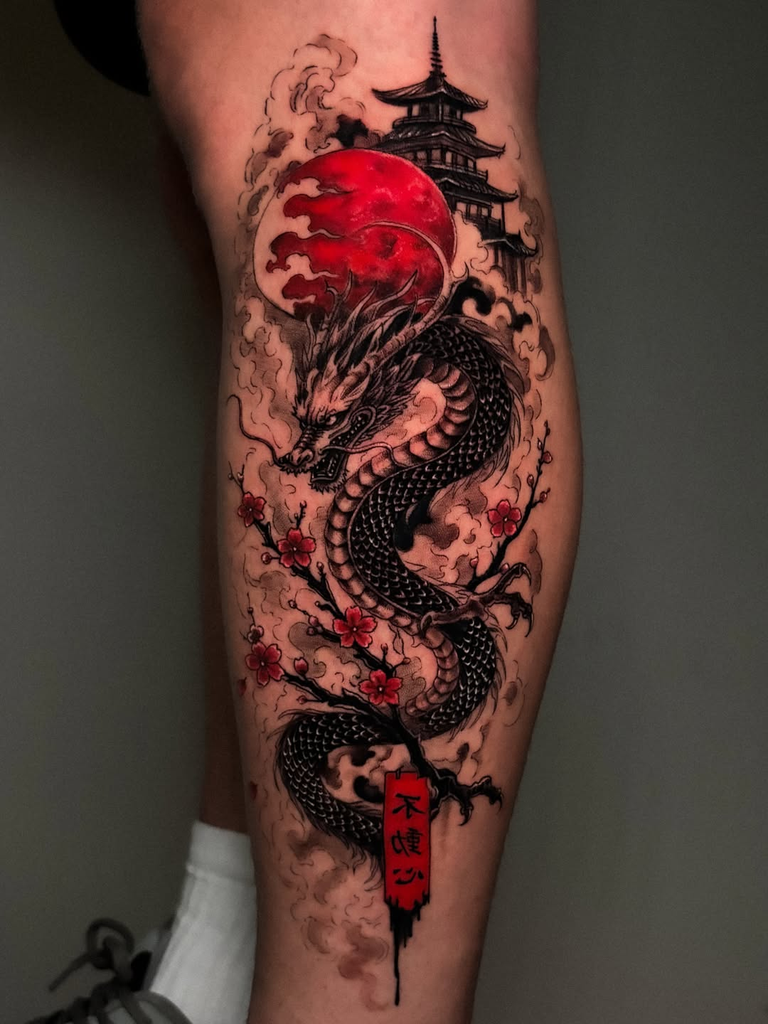
The limited palette keeps attention on the contrast between black and red. Atmospheric smoke fills otherwise empty spaces, while the pagoda, sun, flowers, and dragon establish a layered Japanese-inspired landscape.
Image 8
This contemporary dragon tattoo uses detailed black-and-gray rendering against energetic crimson brushstroke accents. The dragon curves vertically along the limb, with its head positioned near the upper section and its long body forming several sweeping bends before ending in a pointed, flowing tail. Dense scale patterns, layered horns, whiskers, claws, belly plates, and dark dorsal details give the creature a highly textured appearance.

Behind it, broad red strokes resemble expressive ink or paint marks, introducing color without covering the dragon’s intricate details. Small black splatters reinforce the painterly effect. The result combines traditional dragon imagery with a distinctly modern graphic presentation.
Image 9
This black-and-gray Japanese-inspired dragon tattoo combines a powerful serpentine creature with delicate pink cherry blossoms. The dragon’s body forms several broad curves across the limb, creating a layered composition with visible claws, overlapping coils, detailed scales, and segmented belly plates. Its head is especially expressive, featuring an open mouth, long whiskers, flowing hair, and backward-sweeping horns.

Soft gray shading gives the body dimension while preserving the clarity of the fine outlines. Scattered pink blossoms rest across and around the dragon, introducing gentle color and visual contrast. Loose petals extend beyond the main composition, making the design feel organic, graceful, and naturally integrated.
Image 10
This expansive black-and-gray Japanese dragon tattoo extends from the shoulder down the arm, using the available space for an elaborate, continuous composition. The dragon’s large head commands attention around the upper arm, with prominent horns, whiskers, fangs, layered facial contours, and an intense expression. Its scaled body merges into surrounding ornamental elements, including stylized waves and floral forms.
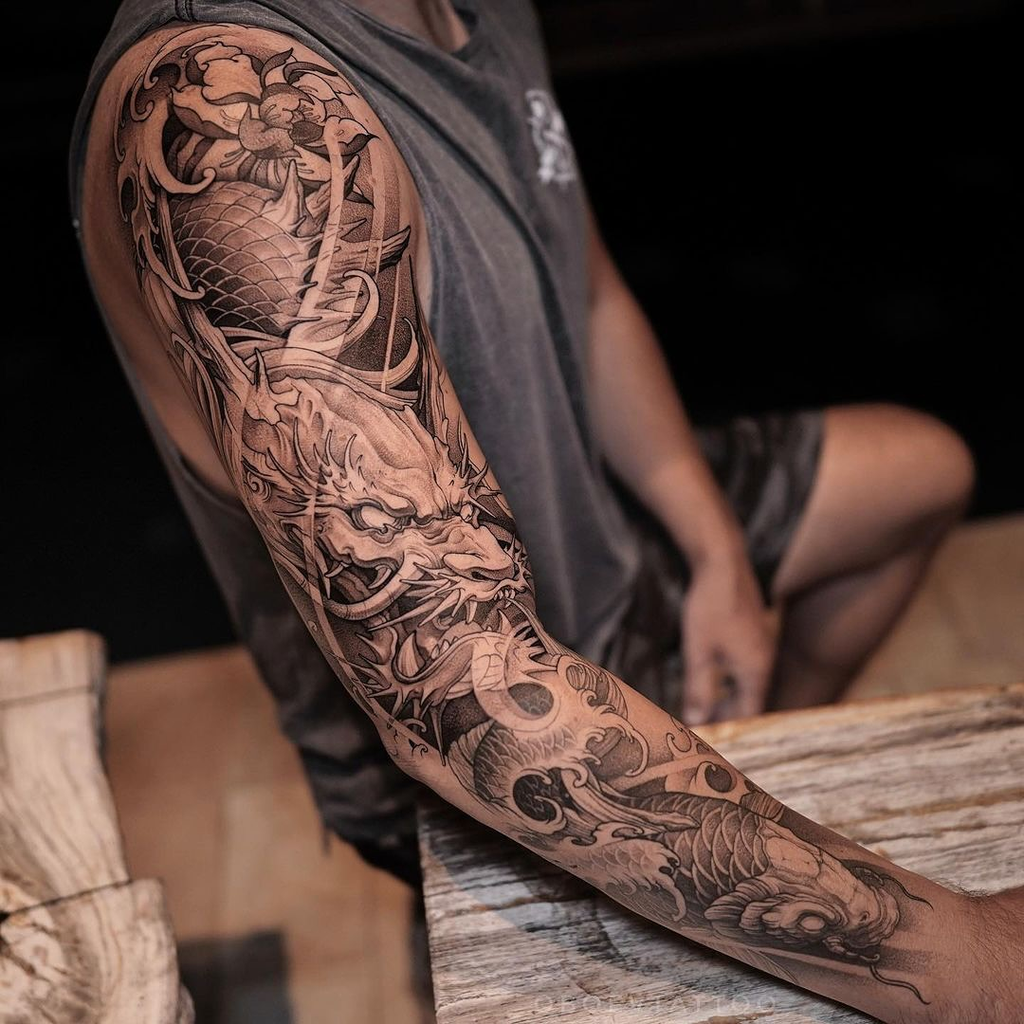
Fine linework is combined with smooth gray shading, stippling, and substantial areas of negative space to separate overlapping details. The forearm introduces stronger wave imagery, creating visual continuity. Overall, the tattoo has the complexity and dramatic scale associated with Japanese sleeve compositions.
Image 11
This dark black-and-gray tattoo creates an imposing composition by combining a coiling dragon with a large demonic mask-like face. The dragon occupies the upper portion, where overlapping scales form a circular curve around its fierce head. Sharp horns, flowing whiskers, an open mouth, and dense linework give the creature an aggressive appearance. Beneath it, the second face introduces another powerful focal point through exaggerated brows, tusk-like fangs, deep shadows, and an intimidating expression.

Repeated scale patterns connect both sections visually. Heavy black shading contrasts with exposed skin, producing depth while allowing important facial details and individual textures to remain clearly distinguishable.
Image 12
This dramatic black-and-gray Japanese-style dragon tattoo emphasizes the creature’s face through bold shading and a tightly cropped composition. The dragon emerges from an intricate field of overlapping scales, waves, and ornamental shapes, creating the impression of a much larger creature wrapping around the limb. Its elongated horns rise prominently above the head, while narrowed eyes, flared facial contours, sharp teeth, and flowing whiskers establish an intimidating expression. Heavy black areas surround lighter sections of skin, creating striking negative-space patterns throughout the design.
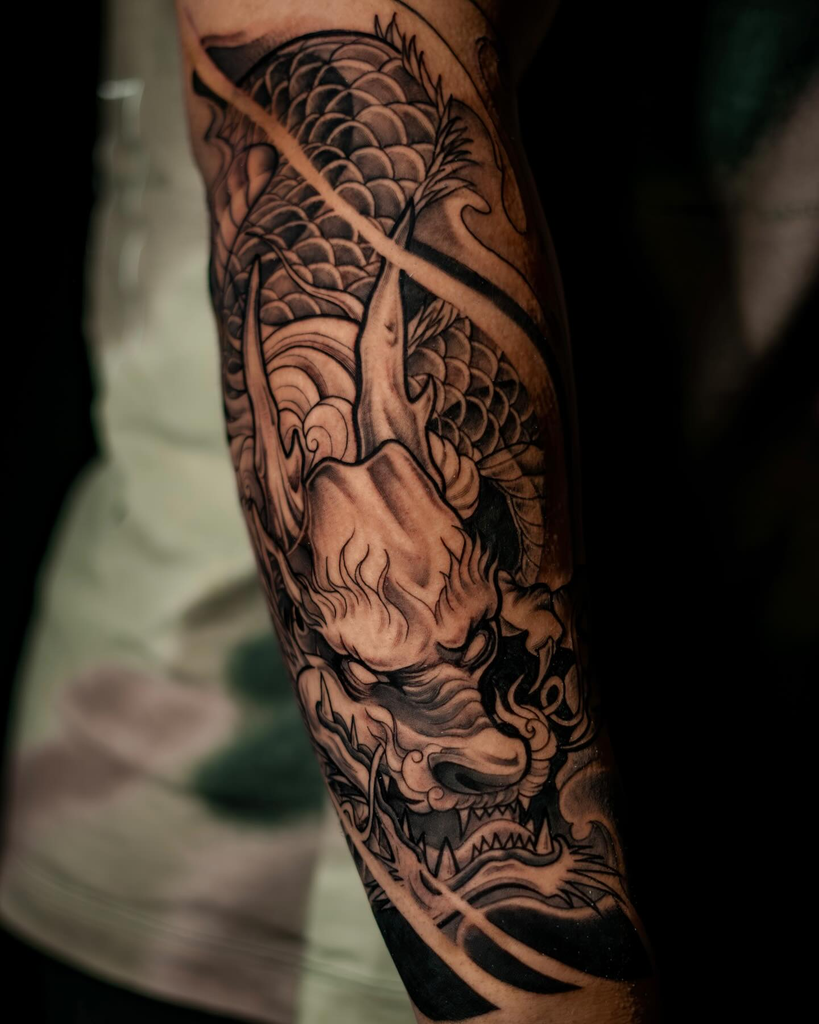
Smooth gray gradients soften transitions between these extremes. The result is dense, powerful, highly dimensional, and strongly influenced by traditional Japanese tattoo aesthetics.
Image 13
This Japanese-inspired dragon tattoo combines a serpentine creature with architectural and landscape imagery in an elongated lower-leg composition. The dragon occupies the upper half, featuring pointed horns, a long neck, layered scales, and a sweeping body that curves toward the scenery below. A traditional multi-tiered pagoda anchors the lower section, surrounded by stylized clouds, hills, and delicate floral accents.
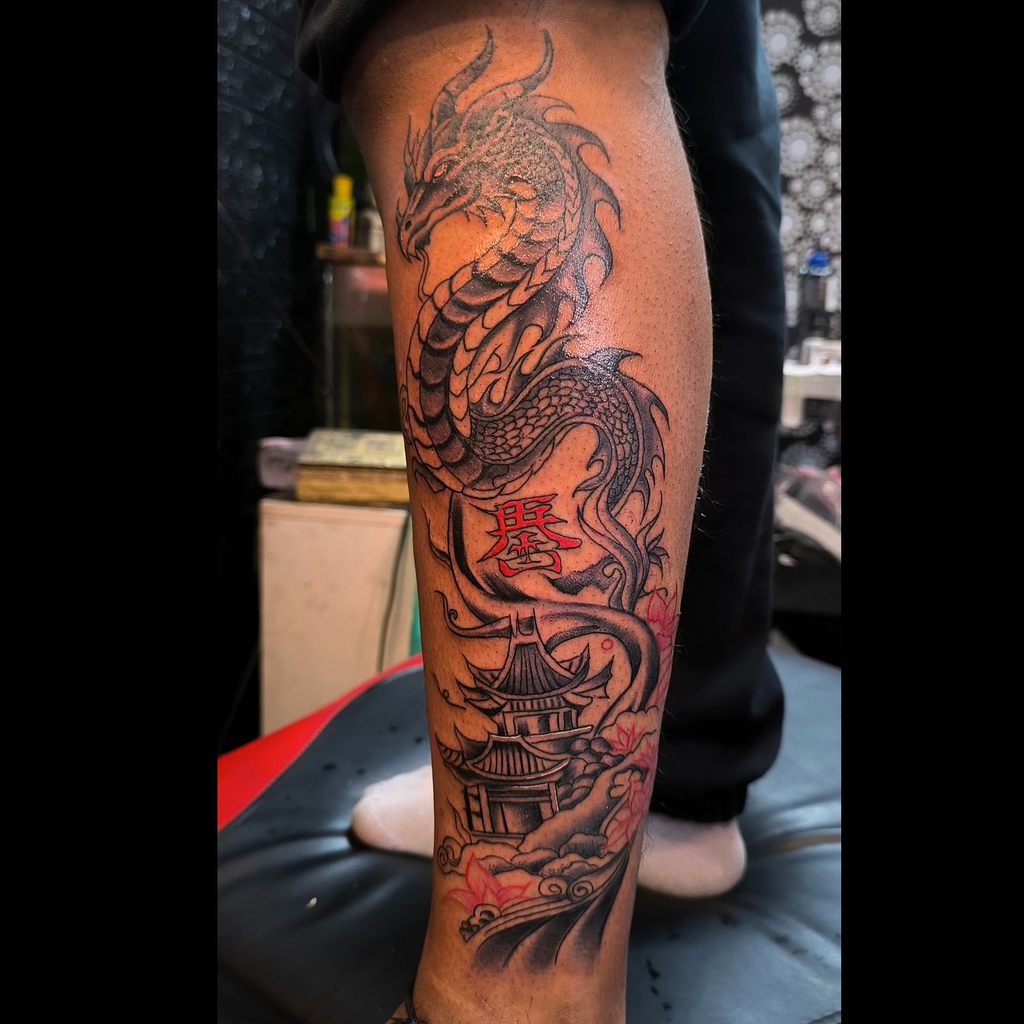
Most of the tattoo uses black and gray, while selective red details appear in the character, flowers, and other small elements. This restrained color palette creates visual emphasis without overpowering the linework. The composition resembles an illustrated Japanese landscape arranged vertically around the dragon.
Image 14
This detailed black-and-gray dragon tattoo follows the length of the lower leg with a powerful serpentine composition. The dragon’s head appears near the upper section, displaying branching horns, flowing whiskers, an open mouth, sharp teeth, and a dark mane that frames its face. Its long body descends through several sweeping curves, covered with tightly rendered scales and broad segmented plates along the underside.
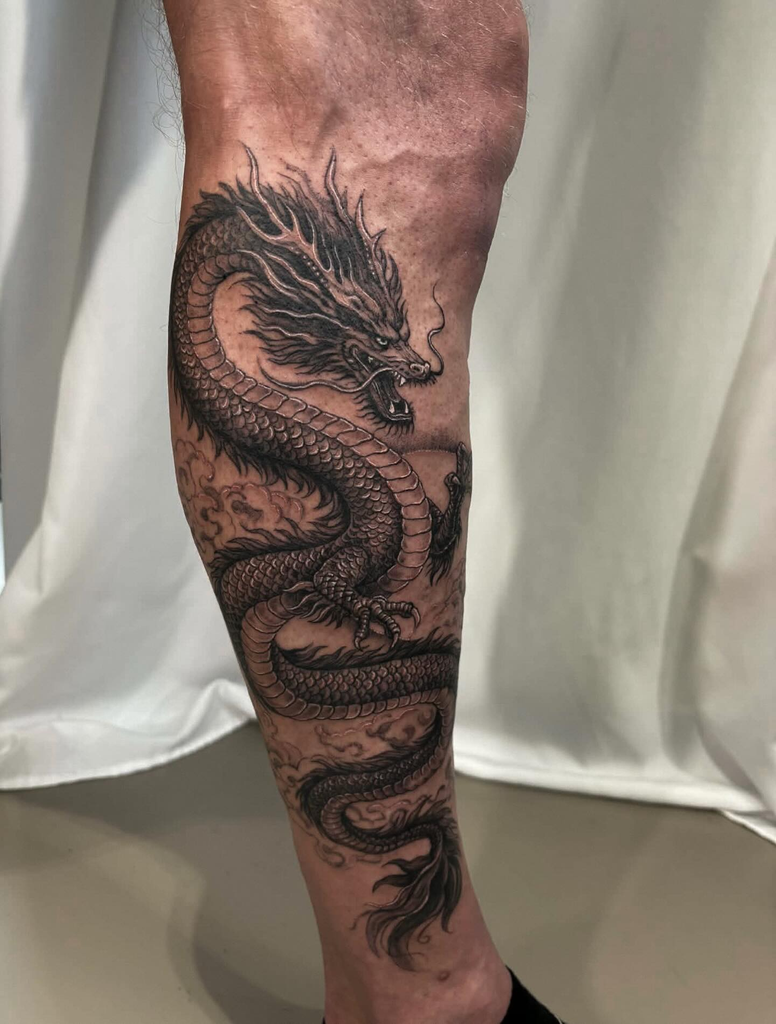
Clawed limbs emerge between the coils, adding anatomical detail and movement. Wispy cloud formations fill selected negative spaces without obscuring the dragon. Dark shading around the scales and mane gives the creature depth, while the flowing tail creates an elegant finish.
Image 15
This black-and-gray upper-arm dragon tattoo presents a traditional serpentine creature moving through clusters of stylized clouds. The dragon’s head rises near the shoulder, featuring an open mouth, long whiskers, prominent horns, and a flowing mane. Its scaled body twists downward in broad overlapping curves, producing a compact composition that fits naturally within the shape of the upper arm.

Dark gray shading gives the scales substantial depth, while lighter belly plates create contrast along the neck and body. Rounded cloud formations weave between the coils, separating different sections of the dragon. The long tapering tail extends downward, finishing the piece with graceful movement.
Image 16
This minimalist Japanese-inspired dragon tattoo takes a delicate ink-painting approach rather than relying on dense traditional shading. The slender dragon curves vertically along the forearm, its elongated body formed with loose black and gray brush-like strokes. Fine details define the expressive head, small claws, flowing mane, and tapering tail, while large areas of exposed skin keep the composition light and airy.
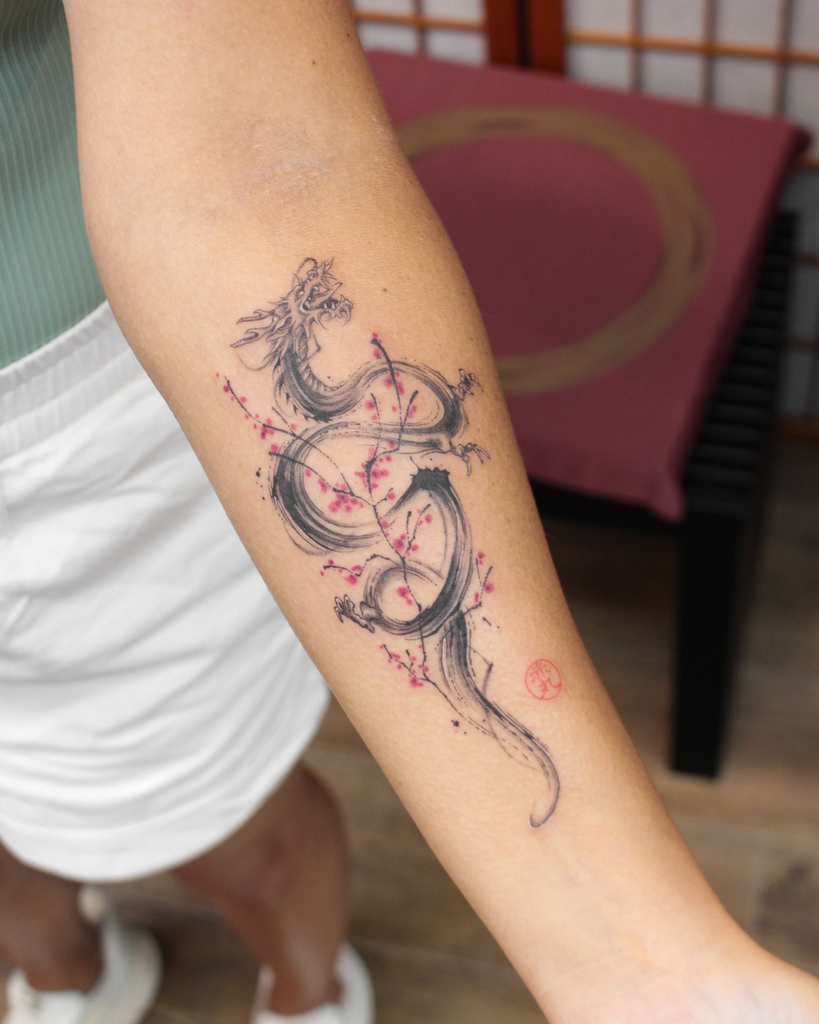
Thin branches decorated with tiny pink-red blossoms intersect the dragon’s curves, introducing subtle color and softness. Small splatters reinforce the hand-painted effect, while a red seal-like mark completes the composition. The result feels elegant, restrained, fluid, and distinctly calligraphic.
Tattoo Aftercare Tips
Japanese dragon tattoos often contain extensive linework, shading, solid black areas, and saturated colors:
- Gently wash the tattoo with mild, fragrance-free soap.
- Apply moisturizer according to your tattoo artist’s aftercare instructions.
- Avoid scratching or picking at peeling skin.
- Avoid swimming and prolonged soaking while the tattoo heals.
- Wear loose clothing to minimize unnecessary friction.
- Protect the healing tattoo from direct sunlight.
- Once fully healed, use sunscreen to help minimize fading.
Following your artist’s aftercare guidance can help preserve detailed scales, strong outlines, smooth shading, and vibrant colors.
Conclusion
Japanese dragon tattoos combine powerful imagery with the flowing visual structure characteristic of Japanese-inspired tattoo compositions. Whether you choose a dramatic full-back dragon, a winding sleeve, a colorful dragon surrounded by flowers, or a black-and-grey interpretation with waves and clouds, the motif provides substantial room for artistic expression. Researching the cultural context and working with an artist experienced in Japanese tattooing can help create a design that is visually cohesive and respectful of the tradition that inspires it.
Frequently Asked Questions (FAQ)
Q1: What does a Japanese dragon tattoo symbolize?
Meanings depend on context, but Japanese dragons can be associated with water, rainfall, protection, power, wisdom, and other ideas rooted in Japanese mythology and religious traditions.
Q2: Where do Japanese dragon tattoos look best?
Popular placements include the back, chest, shoulder, upper arm, thigh, and full or half sleeves. Larger areas allow the dragon’s winding body to flow naturally.
Q3: What can I combine with a Japanese dragon tattoo?
Common accompanying elements include waves, clouds, wind bars, peonies, chrysanthemums, lotus flowers, and other imagery found in Japanese tattoo compositions.
Q4: Do Japanese dragon tattoos look good in black and grey?
Yes. Black-and-grey designs can emphasize scales, movement, texture, contrast, and atmospheric backgrounds, while color can create a more vibrant traditional-inspired appearance.
Q5: Are Japanese and Chinese dragon tattoos the same?
No. Although Japanese dragon traditions have historical connections with Chinese dragon imagery, the cultures developed their own artistic conventions, stories, and symbolic contexts. A knowledgeable artist can help distinguish the visual traditions when developing a tattoo.
